
What I liked about this place was the absolute serenity and tranquility in midst of bustling and exploding city life with tall sky scrapers and choked roads. This was like a breath of fresh air, giving air to lungs and breathing life into your soul. If you really want to relax your body, mind and soul from the hectic routines, go here. Usually, my preference is to mix some kind of gardens or green space into our tour itinerary just to get that freshness and perspective of life. To relax and just be yourself amidst the ruins surrounding us. It’s a getaway within a getaway. A beautifully maintained place it has a sanctum sanctorum within in the form of Nunnery and you can wander around like a lost soul seeking redemption. It’s simply beautiful, refreshing and rejuvenating. Enjoy and immerse yourself in the scenic atmosphere and lose yourself in search of inner peace.
Acknowledgement
http://www.chilin.org/tour/garden/index.html
Opening Hours: 7:00am – 9:00pm
MTR: Diamond Hill station – Exit C2
Address: 60 Fung Tak Road, Diamond Hill, Kowloon Phone: +852 2329 8811
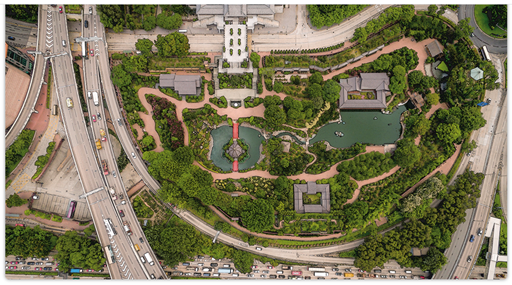
Located in the Diamond Hill area, Nan Lian Garden is built in the Tang Dynasty style and occupies an area of about 35,000 square meters (3.5 hectares). Every piece of land, rocks, trees and water is placed according to rules of Tang style. The garden is designed in a one-way circular route manner. By following this route visitors will see: two water ponds (the Lotus Pond and the Blue Pond), a lot of trees, the Pavilion of Absolute Perfection connected by two Zi Wu Bridges, the Chinese Timber Architecture Gallery, the Pine Path and so on. Also, there is a souvenir shop, a vegetarian food restaurant, a Chinese tea house and a multi-purpose function room.
Admission is Free

The garden is designed with the intention that visitors follow a one-way route and the landscaping is based on the on traditional Chinese techniques such as “borrowing scenes”, “concealing scenes”, “sheltering scenes” and “penetrating scenes” to create space.


The garden is characterized by the four main elements of Tang-style gardens with artificial hillocks and ornamental rocks, water features, timber structures and old trees. The Chinese tradition of “earth enclosing rocks” is adopted for the formation of hillocks in the garden.

The rocks used are mainly from Sanjiang County. Other rocks include Caitao rocks, Heshan rocks, Laibin rocks, Qinghua rocks and hexagonal rocks

Precious old trees throughout the garden include Buddhist Pine, Japanese Black Pine, Cypress, Pagoda, Silver-back Artocarpus and Common Crape Myrte.

Dad, don’t even think or running around those trees and rocks as in Indian movies….first, you cannot run and even if you try to run, you will trip and break your head against those rocks….and even if you manage to do so….you will huff and puff….while the Police will come and put you in jail…

My dear son…can you build something like this for me when you grow up….seriously Mom….you have so much faith and belief in me…Mom growls…

Vidya – Are you taking my picture or the background….I know you are always more interested in the background….
Karthik – come on Dearest….you always fit in picture perfect in all my photos….

Water features such as the Spring, Lotus Pond, Blue Pond, Pine Brook, Moon Wash, Silver Strand and Waterfall were created to resemble their natural states.

In the Lotus Pond is the stunning gold Perfection Pavilion connected by two red painted timber Zi Wu Bridges (not accessible to visitors).

Adjacent to Silver Strand in the northeastern corner of the garden lies Long Men Mou, a three-storey building with plants its balconies and roof and housing the Chi Lin Vegetarian Restaurant. The main path continues between Song Cha Chi on the left and Tang Gallery on the right. Song Cha Xie, built on the northern side of Blue Pond is a Tang-style timber quadrangle with Chinese teahouse. The central courtyard is occasionally used for staging mini-concerts and dramas. The Tang Gallery is a single-storey building with with snack shop and souvenir shop. Beyond the Tang Gallery is the Rockery with indoor displays of rocks from the Hongshui River.


To the left of the pond is Spring Hill, one of the garden’s hillocks with trees and waterfall and surrounded by rocks.


Distinctive timber structures include pavilions, terraces, tower, storied pavilion, waterside pavilion, bridges and the Black Lintel Gate are built in Tang architectural style along the quiet, winding paths.

Just past the Lotus Pond on the south side of the garden is Xiang Hai Xuan (meaning a house embracing a sea of fragrance) flanked on one side by Fragrance Hill with its sweet-scented trees including osmanthus, lily and orange-jasmine. Xuan is fronted by a central courtyard in Tang Style with Ying Shan roofs made of grey tiles and surrounded by a quadrangle with green lawn, ancient trees and rocks. The inner room contains a multi-purpose hall which is hired out for art exhibitions, musical performances and seminars etc.

From the pond visitors can cross the Pavilion Bridge to another water feature The Mill and Silver Strand waterfall.


A short distance beyond Xiang Hai Xuan is the Blue Pond stocked with Koi and with rocks and water features. The Lunar Reflection Terrace and Pagoda Tree Pavilion on the pond’s edge allow visitors to the opportunity to relax and enjoy the pond and reflections of buildings on the opposite side..


One of the most impressive attractions that are a must-see in Hong Kong is the famous Chi Lin Nunnery, located in Diamond Hill right opposite Nan Lian Garden. Housed in a monastery complex, the nunnery is reminiscent of the Tang Dynasty in its architecture, and was built in the 1930s. When the building was renovated in 1998, it was designed so that no nails were used in the reconstruction. It was built in this manner to show the harmonious nature of people with their environment. The Chinese belief is that if houses are built from wood, the life of the trees is much longer. The sections of wood are locked together in the same manner as a jigsaw puzzle. Three different gates, each with its own representation, are at the entrance of the complex. The first gate represents compassion, the second wisdom, and the third, the skills of people.

In the first courtyard of the Nunnery is the Lotus Pond Garden. The garden features lovely water lilies, four ponds, and beautifully-manicured Bonsai Trees. The planters into which the trees are placed are decorated with intricate carved designs. The garden is a place of peace and total tranquility. One of the interesting features of the Lotus Pond Garden is a waterspout in the shape of a dragon’s head. In China, the dragon is the symbol of terrestrial and celestial power. An ancient Chinese myth tells that the dragon controls the rain. Lotus flowers were used in the pond because they are representative of purity.


The Hall of Celestial Kings at the Chi Lin Nunnery has statues of four deities that represent each of the cardinal points, or four compass directions. They are also commonly referred to as the Four Heavenly Kings. In the Buddhist religion, they are protection against evil. It’s very common in China for the four deities to be placed near entrances to temples and holy places. In the center is a statue of the Buddha. Various areas all around the compound have wind chimes hanging from the corners of rooftops where you’ll also see elaborate carved designs.

The main hall of the monastery complex features another statue. This one is of the Sakyamuni Buddha. The impressive hall has a variety of Bonsai Trees placed around the exterior of the structure. Two holy people of the Buddhist religion who are known as Bodhisattva Manjusre and Bodhisattva Samantabhandra are on either side of Buddha. Two of the followers of Buddha are standing with the statue. They are known as Mahakasyapa and Ananda. Chi Lin Nunnery is considered to be one of the most beautiful religious shrines in Hong Kong, and if you love Chinese culture, it is definitely worth an exploring.


How to get there. Take the MTR and get to the Diamond Hill MTR station (MTR Kwun Tong Line). Get out of the station through Exit C2. Go around the Plaza Holywood Shopping Centre and walk a couple of minutes along Fung Tak Road until you reach a pedestrian bridge. The complex will be on your left.
Admission is Free
Know Before You Go:
- Smoking, pets, food and drink, except water, are not allowed in the Garden
- Please dress appropriately so as not to disturb the serene ambience of the Garden, and specially if you will be visiting the Chi Lin Nunnery next door
- Allow about one to two hours to go around, longer if you want to visit all exhibits and displays
 Beautiful Life